
Ise-Shima · Ago Bay
Private Pearl Farm Experience in Ise-Shima, with Hotel Pickup
The cultured pearl was invented in Ise-Shima. A narrow mountain road, just wide enough for a small Japanese car, leads down to a family-run akoya pearl farm on Ago Bay — where you harvest a real pearl with your own hands, or learn to place the nucleus yourself. Fully private, guided in English, and held indoors — so it runs rain or shine. April to November.
- Where
- Ago Bay, Ise-Shima
Mie Prefecture - Season
- Open April–November
Closed December–March - When
- Usually afternoons
1–2 h, or 3–4 h - Indoors
- Runs rain or shine
Good on a wet day - Group
- Fully private
Up to 5 guests - Transport
- Pickup available
if you need it
Travelling between December and March? Please still get in touch — we are happy to suggest one of our other tours for your dates.
Not a museum
A working farm, not a visitor attraction
Ise-Shima has plenty of places to look at pearls. There are museums, exhibition halls and shops with a demonstration counter, and they are well made. This is not one of them.
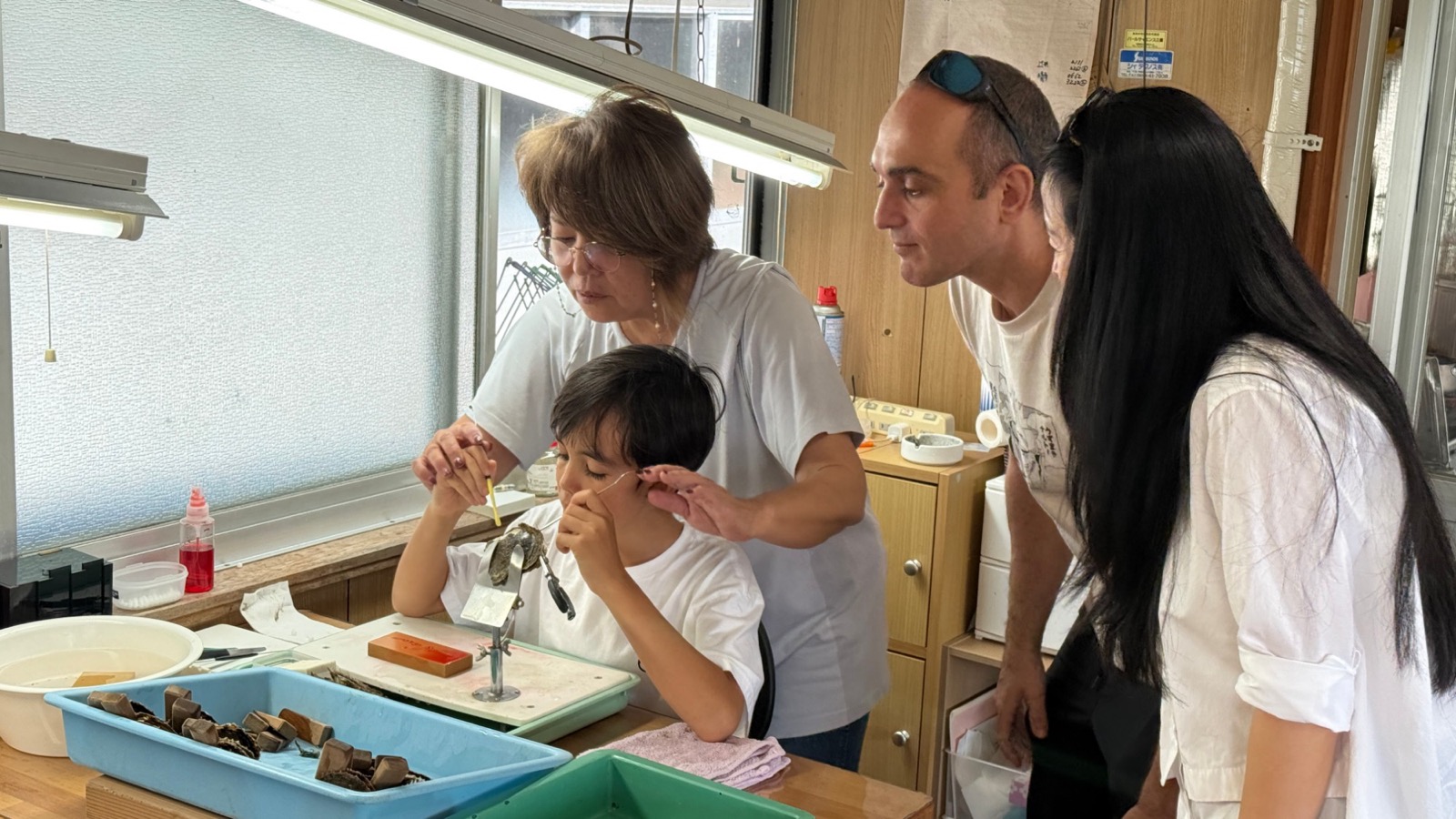
This is a small family farm that grows akoya pearls on rafts in Ago Bay and makes jewellery from them on the same site. Nothing has been built for visitors. There is no exhibition and no set route — there is a workshop, a worktable with the craftsman's tools laid out, trays of pearl oysters, a small shop where the jewellery they make is sold, and the people who do this for a living.
You are not watching pearl farming. For a couple of hours you are taking part in it, next to the person whose work it is.
That is the part travellers remember, and it is the part that cannot be arranged at a counter.
Why private matters here
Only your group — and a car from your door
Every booking is fully private. You are never joined to another group, so the craftsman is working with you rather than addressing a crowd, and your questions are answered as they come up.
This matters more than it sounds, because the farm is small. A few guests at the worktable is a conversation; a coach party is a queue.
It also makes the journey possible. The farm sits at the end of a steep, narrow road with no bus service and nowhere obvious to park. Without a car you simply cannot get there. We collect you from your hotel, drive you in, and bring you back — the drive itself, winding down through the trees to the water, is part of the experience.
| This experience | |
|---|---|
| Who else is with you | Nobody — your group only, up to 5 guests |
| Where it happens | A working family-run farm on Ago Bay |
| Getting there | Private car, from your hotel door |
| Language | Guided throughout in English by a local |
| What you do | Open the shell and take out the pearl yourself |
| What you take home | The pearl you harvested — a real akoya pearl |
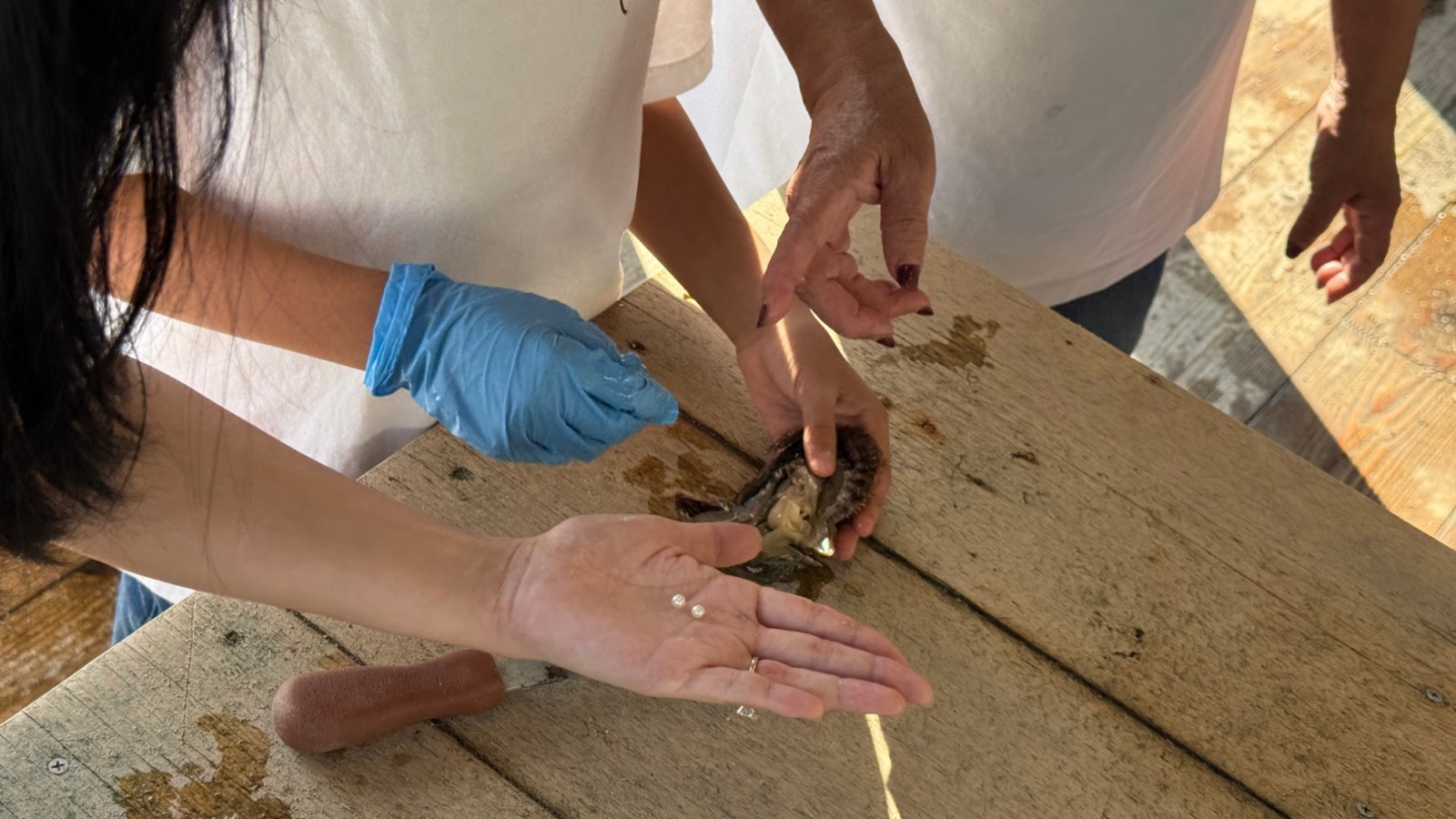
The pearls, moments after the shell was opened.
Choose your experience
Two ways to take part
1 · Pearl Harvesting
Choose an akoya pearl oyster from the farm's own stock and open it with your own hands.
See this experience
At the workshop you are shown the akoya pearl oysters the farm grows on its own rafts in the bay, and you choose one yourself. Then you open the shell and lift out the pearl with your own hands.
Every pearl is different in shape, colour and size, and nobody — not even the farmer — knows what is inside until the shell is open. Some come out perfectly round; others are baroque, with their own irregular shape. That is the nature of it, and part of why it is worth doing.
Afterwards there is time to feed the fish kept beside the rafts, and back at the shop you can have your pearl set into jewellery if you would like to.
- Pickup at your hotel by private car
- Drive up to the farm along the mountain road
- Choose your pearl oyster at the workshop
- Open the shell and take out your pearl
- Feed the fish
- Back at the shop — optional jewellery setting
- Drop-off
Good for: first-time visitors, families with children, and anyone with a free afternoon who wants something they could not have done anywhere else.
2 · Nucleus Insertion & Harvesting
Learn the craft itself — place the nucleus into six oysters, then return them to the sea.
See this experience
Inserting the nucleus is the technique at the heart of akoya pearl farming, and it has been handed down in Ago Bay for generations. Here a craftsman who does it for a living shows you how — and then you do it yourself.
Each guest works on six pearl oysters, placing a nucleus and a small piece of mantle tissue inside each pearl oyster. It is close, delicate work that asks for a steady hand and real concentration.
The pearl oysters you have worked on go into nets and back into the sea. About a year later, any pearls that can be harvested from your own shells are collected and sent to your home address. You also choose a pearl oyster from the farm's stock and harvest a pearl on the day — so you leave with a pearl in your hand, and another one growing in the bay.
- Pickup at your hotel by private car
- Explanation and preparation at the workshop
- Demonstration by a professional
- You insert the nucleus and the mantle tissue — six oysters each
- Your oysters go into nets and back into the sea
- Choose a pearl oyster to harvest, open the shell and take out your pearl
- Feed the fish
- Back at the shop — optional jewellery setting
- Drop-off
Good for: travellers who want to understand how a pearl is actually made, and who like the idea of something of theirs still growing in Ago Bay a year after the trip ends.
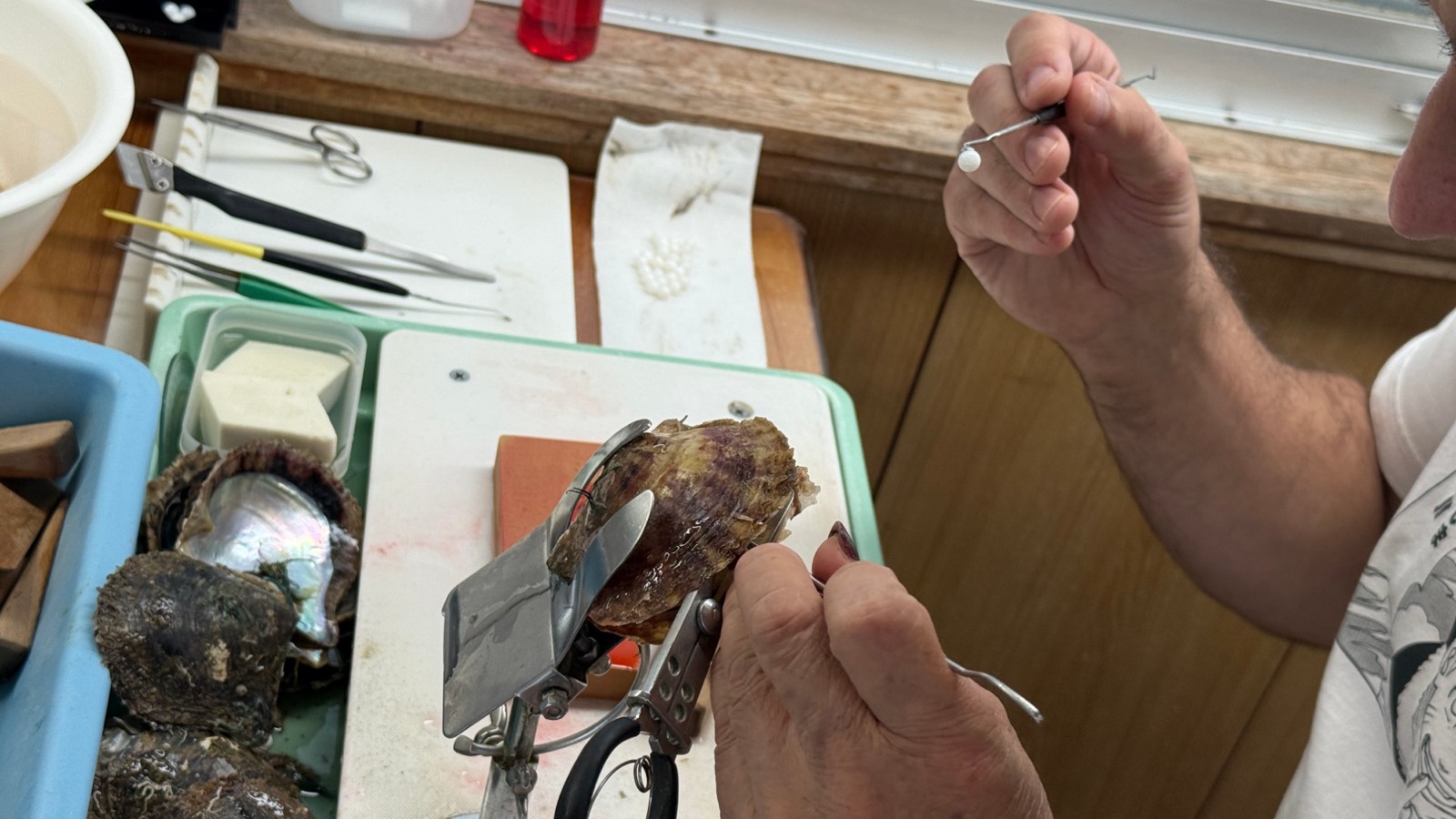
The nucleus — the small bead that becomes the centre of the pearl.
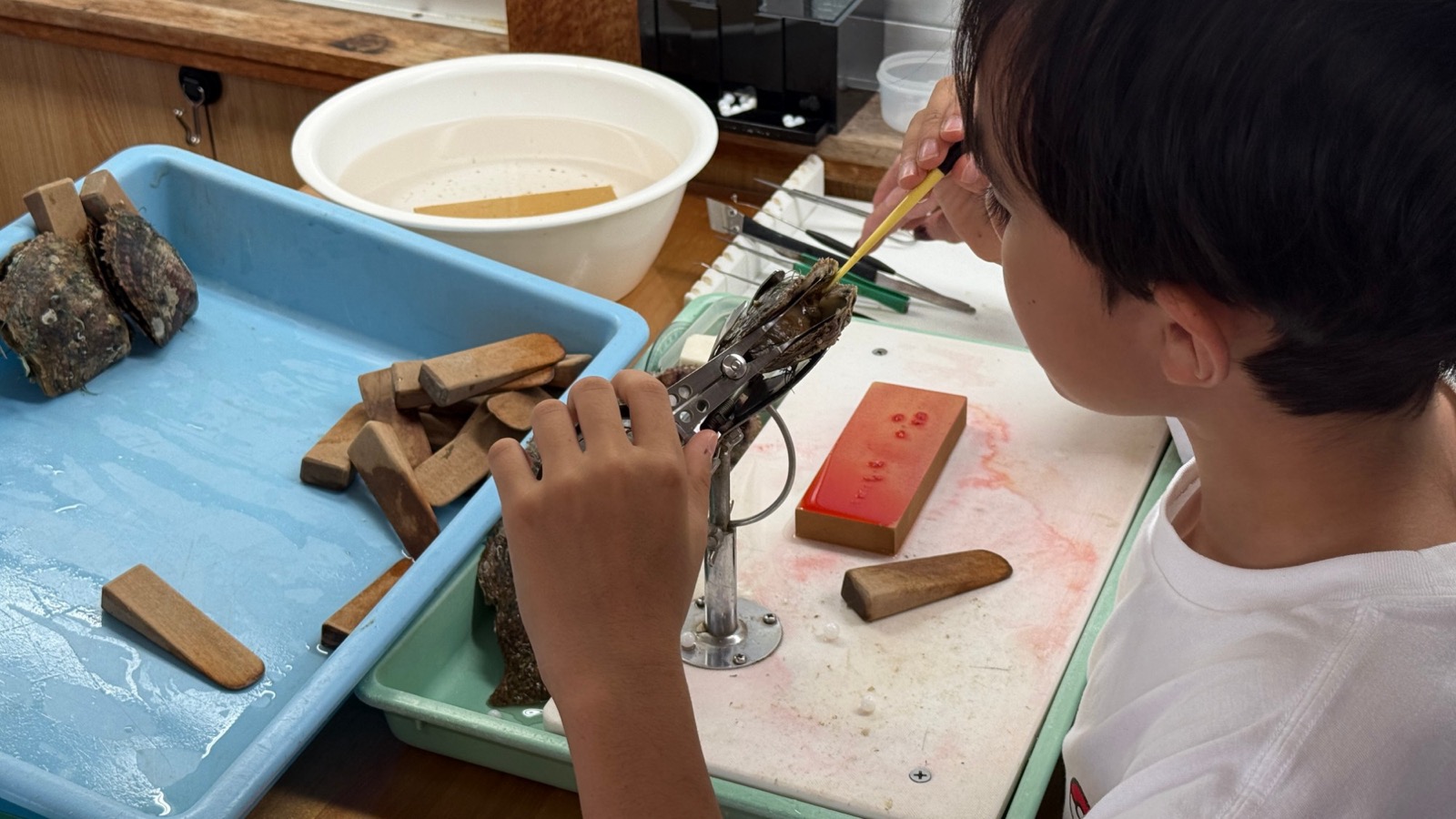
Close, careful work — guided by the craftsman at every step.
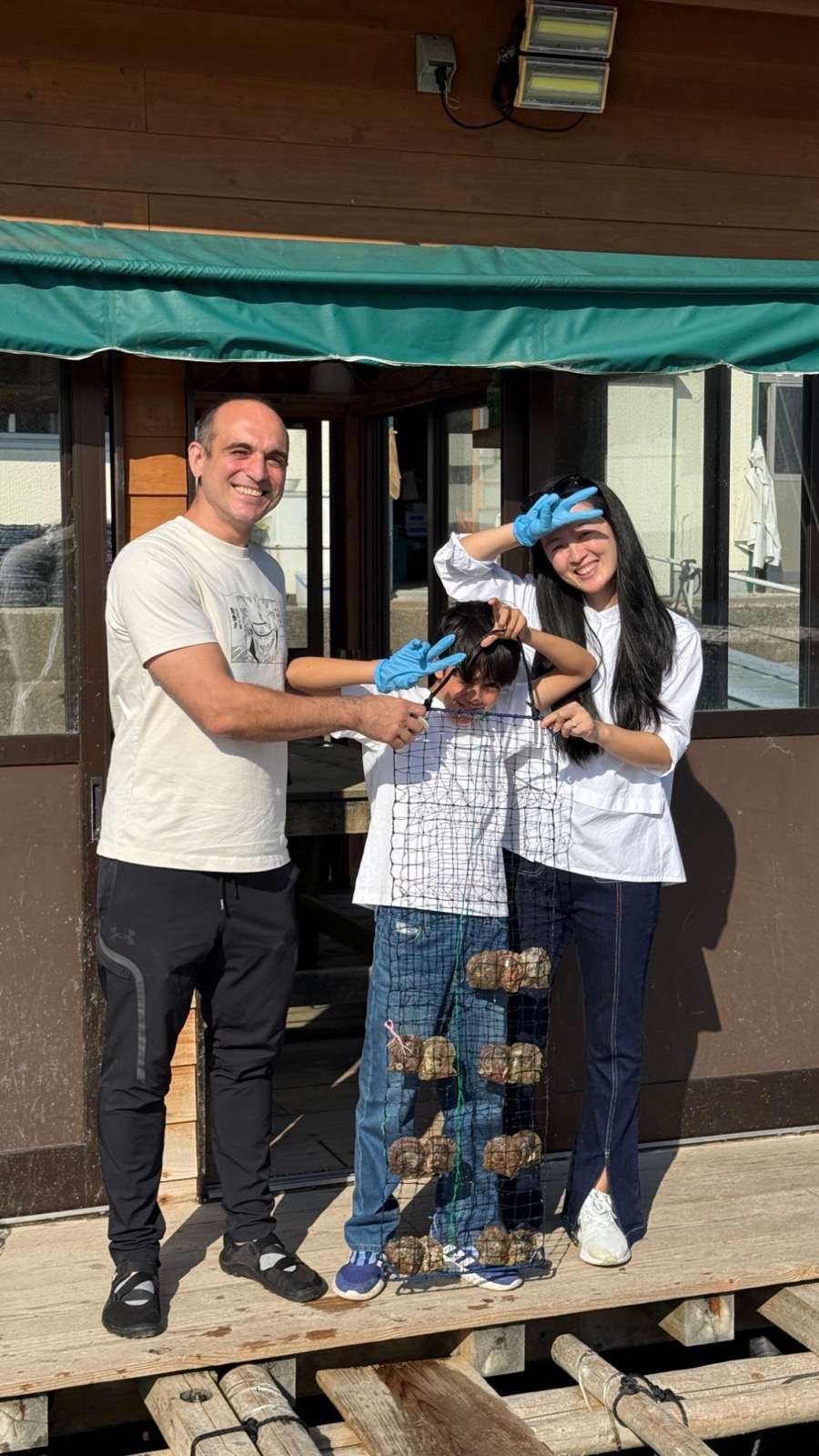
Your own shells, in the net, on their way back into the bay.
Practical
Getting here, and what to expect
Pickup and travel times
Pickup and drop-off are included at no extra cost for guests staying in the Ise, Toba and Shima areas, if you need it. If you are staying elsewhere, we meet you at Ugata Station.
- From Osaka — about 2.5 hours by limited express train, no transfers
- From Nagoya — about 2 hours by limited express train
- From Kyoto — about 3 hours, usually with one change
Ise-Shima is reachable as a long day trip, but it is much better as an overnight stay.
This is a single activity, not a full day with a guide. The transport above is to and from the pearl farm for this experience. We also run other tours — Ise Jingu, or a full day along the coastline — and you are welcome to book one of those alongside this experience. They are priced separately and need to be booked in advance.
What's included
- The experience fee at the pearl farm
- Transport to and from the farm, with pickup and drop-off if you need it
- An English-speaking local guide throughout
- The pearl you harvest on the day
What's not included
- Meals and personal shopping
- The cost of having a pearl set into jewellery, if you choose to have this done
Good to know
- The experience runs from April to November only. From December to March the pearl oysters are moved to warmer water to protect them from the cold, so the farm cannot take guests.
- We confirm the exact time with the farm when you book.
- Maximum 5 guests per booking. If your group is larger, please ask — we will see what can be arranged.
- The work takes place inside the workshop, so the experience runs rain or shine — a good choice for a wet day in Ise-Shima.
- Jewellery setting depends on the workshop's schedule on the day — we check it for you with every booking.
- The nucleus insertion experience is technical and may be difficult for younger children.
- Not every pearl oyster you work on survives the year; in some cases no pearl can be collected.
Taking part — please read
The workshop is a working space, and the nucleus insertion uses fine, sharp hand tools. You take part at your own risk and remain responsible for your own health and safety. Please follow the craftsman's and the guide's instructions at all times, and stay within the areas you are shown.
Please tell us in advance about any medical condition, allergy, pregnancy or mobility need that could affect your visit, so that we can advise you honestly. Children remain the responsibility of the adult accompanying them.
We are not responsible for injury, illness, loss or damage other than where it is caused by our own fault.
Cancellations are handled under our standard cancellation policy — the full terms are on our main site and in our legal notice.
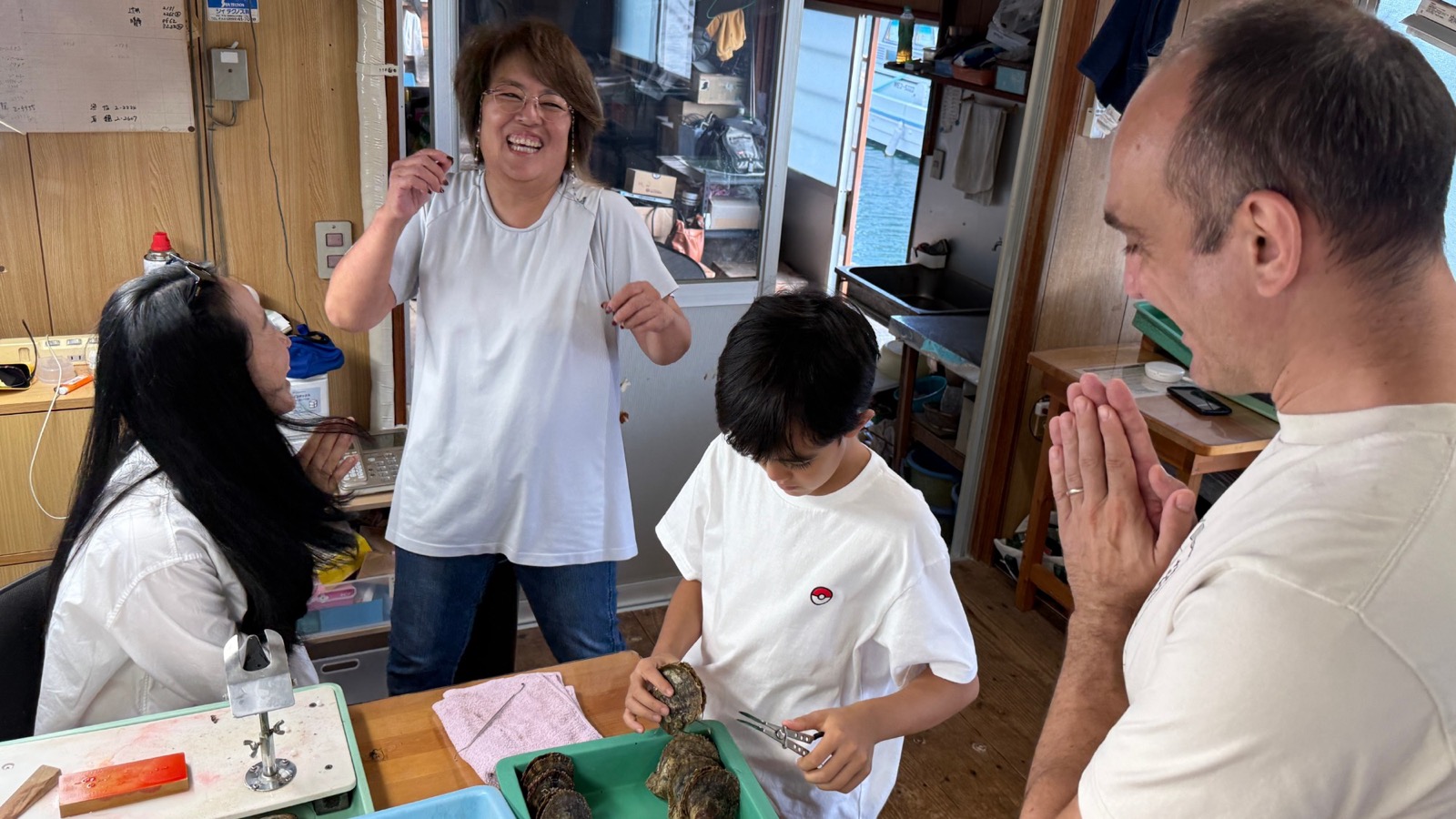
A small farm, an afternoon's work, and people who are glad you came.
Questions
Frequently asked
Is this a real pearl farm or a museum?
It is a real, family-run akoya pearl farm on Ago Bay. The people who show you the work are the people who do it for a living, and the pearl oysters come from the farm's own rafts. There is no exhibition hall and no visitor circuit — you are in the workshop where the pearls are actually produced, with a small shop beside it selling the jewellery they make from their own pearls.
Is the experience private?
Yes. Every booking is fully private — only your own group, up to five guests. You are not joined to other travellers, so the craftsman works with you directly and your questions are answered as they come up.
Is hotel pickup included?
Yes. Pickup and drop-off are included at no extra cost for guests staying in the Ise, Toba and Shima areas, if you need it. If you are staying elsewhere, we can collect you from Ugata Station, which is reached from Osaka in about 2.5 hours by limited express train with no transfers. The farm is on a narrow mountain road with no bus service, so transport is part of the experience rather than an extra.
Do I keep the pearl I harvest?
Yes. The pearl you take out of the shell on the day is yours to keep. These are real akoya pearls, so some come out perfectly round and others are baroque, with their own irregular shape — nobody knows what is inside until the shell is opened.
What is the difference between the two experiences?
Pearl Harvesting takes one to two hours: you choose a pearl oyster from the farm's stock and open it yourself. Nucleus Insertion and Harvesting takes three to four hours: a craftsman teaches you to place a nucleus and mantle tissue into six pearl oysters, which then go back into the sea for about a year, and you also harvest a pearl on the day.
What happens to the oysters I work on in the nucleus insertion experience?
The pearl oysters go into nets and back into Ago Bay for about a year. Any pearls that can be harvested from your own shells are collected and sent to your home address. Not every pearl oyster survives the year, and in some cases no pearl can be collected — the odds vary considerably with the season.
Can children take part?
Children are welcome at the harvesting experience and usually enjoy it a great deal. The nucleus insertion experience is close, delicate work with fine tools and may be difficult for younger children.
Can I have my pearl made into jewellery?
Often, yes. The same site makes jewellery, so a pearl can be set into a pendant or a ring at the workshop. This depends on the workshop's schedule on the day, so we check it for you with every booking.
How much does it cost?
The price depends on which experience you choose and how many guests are coming. Send us your dates and group size, and tell us whether you would like to be collected and from where, and we will come back to you with the price.
How far in advance should I book?
As early as you can. This is a small working farm and every booking has to be confirmed with them before it is final, so a few days' notice makes a real difference — especially in spring and autumn.
What months is the experience available?
April to November. From December to March the farm moves its pearl oysters to warmer water to protect them from the cold, so the experience cannot run in those months. If your trip falls in winter, we are happy to suggest one of our other tours instead.
What if it rains?
The work takes place inside the workshop, so the experience runs rain or shine. It is one of the better things to do in Ise-Shima on a wet day, when the coastline and the lookouts are less rewarding. Rough weather at sea can occasionally affect the farm's own work, in which case we will contact you and arrange another date.
Can this be combined with Ise Jingu or other sightseeing?
This is a single activity rather than a full day with a guide. Ise Jingu and our other tours are priced separately, and you are welcome to book one alongside this experience. They need to be booked in advance, so please tell us what else you would like to see when you enquire.
Ask us
This is a small working farm, so every booking is confirmed with them before it is final. Send your dates, the number of guests, which of the two experiences you would like, and whether you would like us to collect you — we will check with the farm and come back to you with availability and the price.
Send an enquiryinakatoursjp@gmail.com · +81 90-5366-1544
While you are here